Inspiration
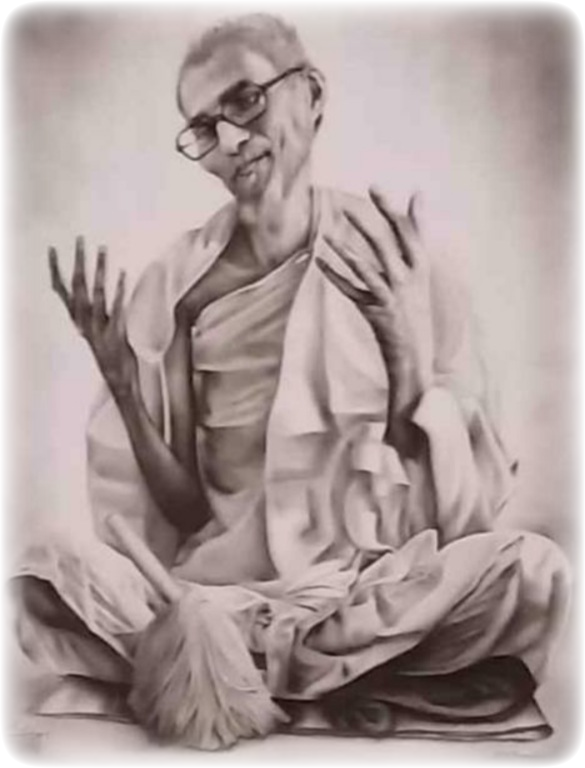
Muni Shri Hitruchi Vijayji Maharajsaheb
Muni Shri Hitruchi Vijayji Maharajsaheb took to the life of renunciation when he was 23 years old and became a Jain monk in 1991.
The impermanence of life, preciousness of the human birth and the potential for revolutionary leaps of consciousness a human being is capable of, are truths which Hitruchi Maharajsaheb grasped at a very young age. Inner purification and upliftment of consciousness have been the single focus purpose for him ever since.
His name was Atul Shah when he led a sansari life prior to this, and belonged to a Jain businesss family, well known in the diamond industry, and respected for their commitment to ethics and quality.
There is a unique vision, which Maharajsaheb (Jain monks are addressed as Maharajsaheb) is known for, not only within the Jain community, but also among people in the fields of organic farming, khadi weaving and vegetable dying, traditional handicrafts, Gau raksha, developmental economics, village regeneration programs and among dignitaries at various positions in the government:
Maharajsaheb was very insistent on consumerism based on products made by craftsmen producing traditional items, while residing in their native villages as integral part of one’s life, as opposed to factory produced goods.
Going further, he is also has clear guidance on the WAY to go about this.
“Implement the knowledge of the Shastras” is Maharajsaheb’s guidance in a nutshell.
He points to the Shastras and ancient Indian texts as the source to derive the know-how of how to fulfil this aim. The Shastras are a rich source of knowledge not only with spiritual guidance, but also with scientific principles of every discipline and field of work, commerce and management strategies, logic, ethics, philosophy, principles of governance and a lot more.
Just the way any product we get today is available as an outcome of
its background economic structure- globalisation, getting a supply of
naturally and non-violently produced products requires its own
background economic structure which will have those values at
every structural level, from production to distribution.
To create this structure requires knowledge of its know-how. And this
is available in the Shastras.
The landscape of Hitruchi Vijayji Maharajsaheb’s spiritual guidance,
his life’s work, his teachings and
principles applied to his own life……all point to one direction:
The consideration for the way you live, and the thought
process behind smallest of actions- the things you consume
in your daily life, the way you use those things, the way you
discard them, the reason why you use them, the cost at
which they have been made available to you- all these
considerations are required at a fundamental level of your
spiritual journey.
A consciousness devoid of this consideration compassion at the fundamental level, where there is no care for the real cost of the lifestyle we lead today (human cost, environmental cost, cultural cost, economic cost), will inherently not have the depth to rise beyond a certain extent.
Today, it is almost impossible to find products which haven’t
propagated violence towards other living beings or the environment.
Food products in the market are full of animal bi-products in some form or another; medicines, cosmetics and bath products are tested on animals using cruel methods; generation of electricity and water supply is only possible due to the millions of people who had to be displaced from their ancestral lands and due to cutting of dense forests; loss of traditional arts, crafts, cultural indigenous knowledge systems; loss of livelihoods; presence of toxic chemicals in almost all
consumer items; factory farming for dairy and meat…….the list is almost endless. Not to mention the waste which humanity has to deal with: bio-waste, hazardous nuclear-waste, e-waste, plastic waste, toxic chemical waste.
While we pleasantly enjoy the comforts of the modern life and technology, we turn a blind eye to the cost at which it is made available to us.
One will always find Maharajsaheb guiding people to be involved in activities where there is “Swa Kalyan” (spiritual upliftment for self) and “Par Kalyan” (upliftment of the society and others). A lifestyle based on compassionate consumerism merges both these values of upliftment for self and others perfectly.
This has led to two developments-
1) A large number of people and families have re-oriented their lives to imbibe spiritual values in their daily lives (Swa Kalyan) while adopting this way of life which causes less harm to other living beings.
2) A large number of working professionals and businessmen have turned away from their conventional business fields (where violence towards animals and other living beings and environmental pollution are inherent), and are now working in areas of organic farming, hand woven khadi, vegetable dying, hand made paper, ink and colours, handicrafts, village economy regeneration, traditional vessels (made of brass, kasa and copper) and eco-architecture.
“Uncompromisingly dedicated to locality, he has taken great pains to ensure that all the material needs of his community are based on the use of neighbourhood resources. In his public functions, no use is permitted of materials that have emerged from the industrial economy. All food consumed and served within the community must be grown by organic means alone: pesticides do too much violence to living creatures from the microbes in the soil to the birds and the bees, in addition to harming the health of human beings. His insistence on local industry has spawned and also led to the revival of several indigenous industries, from metal-working to calligraphy.”